
Annealing Gold and Silver
A Guide to Annealing Gold and Silver
Stephen Gregory Saliba
7/26/20262 min read
How to Anneal Gold and Silver
Annealing is the process of softening metal. Gold and silver work harden and need to be annealed regularly while working to prevent cracking. Usually the hardening material that is added to gold and silver is copper. Copper is a larger atom than gold or silver and when it is added it hardens the alloy and also reduces its melting point. Other metals can be added to these alloys that can affect the hardness, but here I am going to focus on the annealing of sterling silver and yellow golds of various karats.
For example, if you make an ingot to make some sheet in gold or silver, it is good practice to anneal the ingot after smelting and before you start to mill the metal. When compressing the metal in the rolling mill the ingot will harden after each pass through the mill. This is because the silver and gold are being pressed up against a copper atom and the copper acts as a stop. As a guide I like to anneal every 0.5 mm but sometimes I may anneal more frequently, depending on the delicate nature of the work in hand.
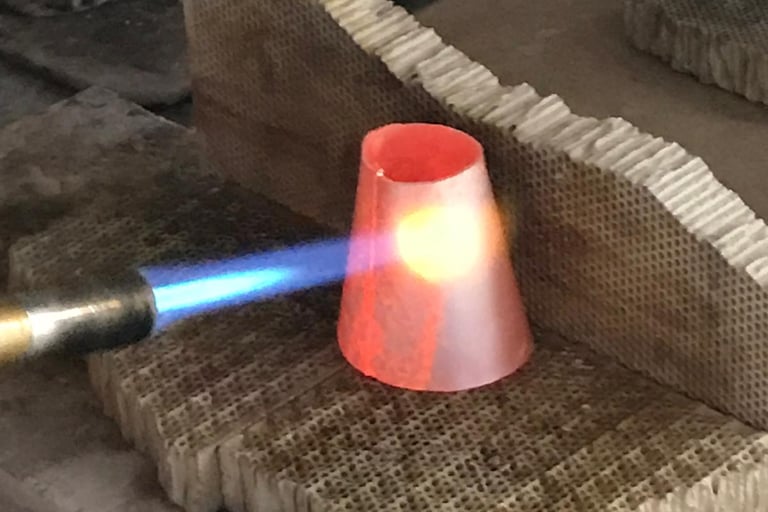
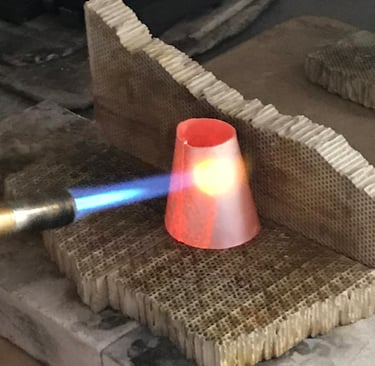
How to anneal: the metal needs to be heated with a flame until it starts to become red hot. It is important to try to keep the metal uniformly hot before quenching. Silver wants to reach a colour of cherry/dull red and once you are happy that the metal has all been evenly taken to dull red then it can be quenched in water. The lighting in the workshop is important to be at a normal level, not too dark or bright, but with no direct light on the work. The annealing temperature for sterling silver is between 600°C to 650°C. It is important not to overheat which can be easily done if the lighting in the room is too bright.
Annealing gold temperatures can vary depending on its colour and karat but between 600°C to 700°C but generally it is usual to take the gold up to a red hot colour and hold it at that temperature for about a minute and then quench. Quenching in water works, but you achieve a far superior softening by quenching in methylated spirits or alcohol. Quenching in spirits gives it a slow quenching that is very satisfying to watch. You can see how gold quenches in spirits in this video.

To book a class in our studio
Via Augusto Ciuffelli 8 Todi (PG) 06059
Privacy policy
stephen@artlabtodi.com
+39 3713909711